

Blog
Gold and Diamond Detector Machine: How the Technology Works and What to Know
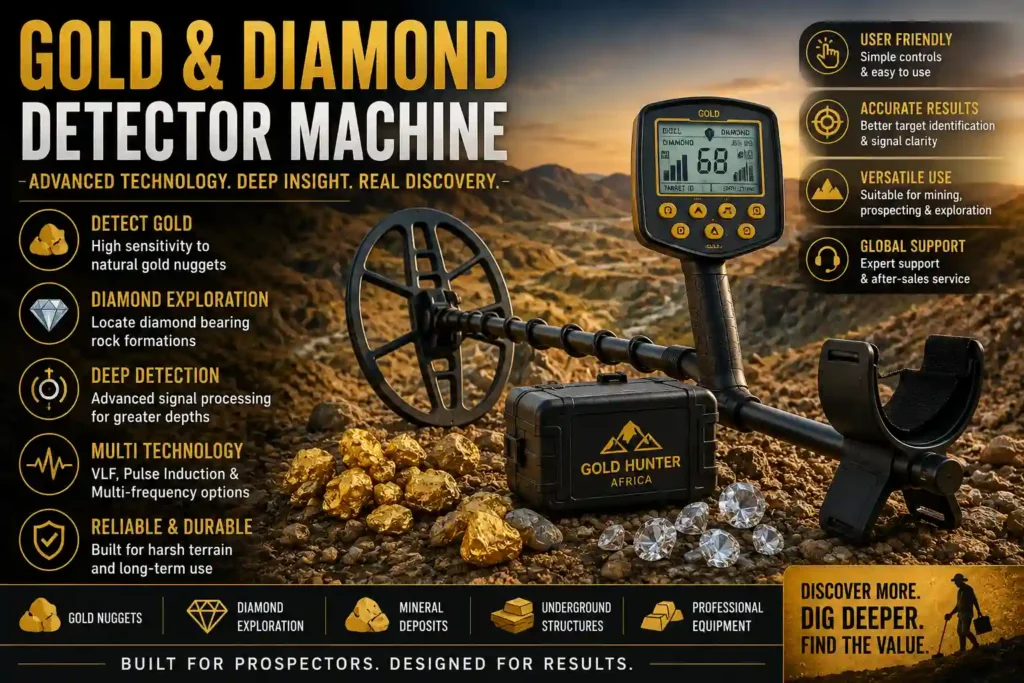
A gold and diamond detector machine is designed to help users search for valuable targets and geological indicators beneath the ground. These machines are often marketed toward prospectors, miners, and people interested in locating natural resources.
However, it is important to understand what different detection technologies can actually identify. Gold is a metal and can produce an electromagnetic response that a suitable metal detector can process. Diamond is different because it is a non-metallic form of carbon.
This distinction matters when comparing detector machines and evaluating product specifications.
What Is a Gold and Diamond Detector Machine?
The term gold and diamond detector machine is commonly used in the detection equipment market for machines promoted for gold prospecting and diamond-related exploration.
Different products use different technologies. Some are conventional metal detectors designed to locate metallic targets. Others may use specialized scanning systems and claim to identify underground geological features or indicators associated with mineral deposits.
Because manufacturers use different technologies and terminology, it is important to examine the technical specifications of each machine rather than relying only on the product name.
Can a Metal Detector Detect Gold?
Yes. Metal detectors can detect gold because gold is electrically conductive.
A metal detector uses an electromagnetic field to interact with conductive targets. When the detector encounters a suitable gold object, the target can produce a measurable response.
The strength and quality of that response depend on several factors, including:
- Gold size
- Gold shape
- Gold purity
- Target depth
- Soil mineralization
- Search coil
- Detector technology
- Operating frequency
- Sensitivity settings
Small natural gold can be particularly challenging to detect because it may produce a relatively weak signal.
Can a Metal Detector Detect Diamonds?
Diamonds are not metals, so a conventional metal detector does not detect a diamond in the same way it detects gold, silver, copper, or iron.
A diamond is made of carbon and does not normally produce the type of electromagnetic response that a conventional metal detector is designed to identify.
This means consumers should carefully examine claims made about machines described as diamond detectors.
Some specialized systems marketed for diamond exploration may use different approaches, such as geological surveying or detection of associated minerals and underground structures. These systems should not automatically be considered conventional metal detectors.
How Gold Detection Technology Works
Gold detector machines generally use electromagnetic technology to identify conductive targets.
The search coil creates an electromagnetic field. When the field interacts with a conductive object, the detector receives a change in the signal and processes the response.
Two common technologies used in gold detectors are VLF and Pulse Induction.
VLF Gold Detectors
Very Low Frequency detectors use a continuous electromagnetic signal.
Many VLF machines include ground balance, sensitivity controls, discrimination, and target identification features.
Gold-focused VLF detectors may be designed to provide sensitivity to small targets. Their performance can vary significantly depending on soil mineralization and detector settings.
Pulse Induction Detectors
Pulse Induction detectors transmit short electrical pulses into the ground and measure the returning response.
PI technology is commonly used for gold prospecting, particularly in mineralized environments where ground conditions can make detection more difficult.
The capabilities of PI detectors vary between models, so users should compare the actual specifications rather than assuming every PI detector performs in the same way.
Why Ground Conditions Matter
The ground beneath a detector can have a major effect on its performance.
Mineralized soil can produce strong responses that interfere with target signals. This is particularly relevant in many gold-bearing environments.
Ground balance systems help detectors compensate for some of these effects.
Other factors such as soil moisture, salt content, rocks, electrical interference, and terrain can also influence detection.
For this reason, a detector’s performance in one location should not automatically be expected to be identical in another.
Features to Compare
When comparing a gold and diamond detector machine, look beyond the product name.
Detection Technology
Determine whether the machine uses VLF, Pulse Induction, multi-frequency, or another technology.
Understanding the operating principle provides more useful information than a general marketing description.
Ground Balance
Ground balance can be particularly important when operating in mineralized soil.
Look for information about whether the machine offers automatic, manual, preset, or tracking ground balance.
Search Coil
The search coil influences coverage, sensitivity, target separation, and handling.
Different coil sizes can be suited to different environments and search conditions.
Operating Frequency
Operating frequency can influence the detector’s response to different targets.
Higher frequencies can have useful characteristics for small conductive targets, while lower frequencies can behave differently with larger or highly conductive targets.
Frequency should always be considered alongside the detector’s complete design.
Sensitivity
Sensitivity controls how responsive the detector is to potential targets.
Increasing sensitivity does not always improve results. Highly mineralized or electrically noisy environments can produce unwanted responses when sensitivity is set too high.
Display and Target Identification
Some machines provide numerical target information, audio tones, visual indicators, or other forms of feedback.
These features can help operators interpret signals, but target identification should not be treated as absolute proof of the target’s identity.
What Should You Look for in a Gold Detector?
If your primary goal is natural gold prospecting, consider a detector specifically designed for gold detection.
Important factors include:
- Sensitivity to small targets
- Ground balance
- Search coil design
- Operating technology
- Operating frequency
- Mineralized-ground performance
- Battery life
- Weight
- Available operating modes
- Manufacturer specifications
The appropriate combination depends on your intended environment and level of experience.
Gold and Diamond Detector Machine Claims
When researching these machines, it is important to distinguish between a product’s stated features and claims about what it can find.
Terms such as “deep detection,” “long-range detection,” “gold and diamond detection,” or “multiple target detection” can mean different things depending on the technology being used.
A responsible buyer should look for clear technical information explaining how the machine detects a particular target.
Avoid judging a machine solely by advertised depth or claims about detecting valuable materials from extremely long distances.
Actual performance depends on the equipment, target, soil, environment, and operating conditions.
Gold Detector Machines for Africa
African markets include a wide range of geological environments, from mineralized inland soils to coastal areas and established mining regions.
This makes selecting suitable detection technology particularly important.
For gold prospecting, consider the mineralization of the ground and whether the detector provides appropriate ground-balancing capabilities.
Before detecting on private property or protected land, check the applicable local requirements and obtain permission where necessary.
Rules governing prospecting, archaeological sites, protected areas, and mineral resources can vary by country and location.
Gold Detector vs Gold and Diamond Detector
A conventional gold detector is primarily designed to detect metallic targets and is often optimized for natural gold prospecting.
A machine marketed as a gold and diamond detector may use additional technology or may simply use broader terminology in its product description.
The important question is not what the machine is called but how the machine detects the target.
Review the technology, specifications, operating method, testing information, and intended application before making a decision.
Is a Gold and Diamond Detector Machine Right for You?
The answer depends on what you are actually trying to locate.
If your primary objective is natural gold, a specialized gold detector using VLF or Pulse Induction technology may be more relevant than a machine marketed with broad claims.
If you are researching diamond exploration, conventional metal detection alone is not sufficient because diamonds are non-metallic. Geological exploration methods and specialized equipment may be required depending on the objective.
Understanding this difference can help you avoid choosing equipment based solely on a product name.
Final Thoughts
A gold and diamond detector machine can refer to several types of detection equipment, and the technology behind each product matters.
Gold can be detected using suitable electromagnetic metal detection technology. Diamonds are fundamentally different because they are non-metallic, meaning a conventional metal detector does not detect them in the same way it detects gold.
Before choosing a machine, examine its detection technology, ground balance, search coil, operating frequency, sensitivity, specifications, and intended application.
